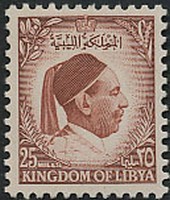
Accession of King Idris I (1890–1983) - 25 millieme
King Idris I (1890–1983) was the founder and sole monarch of the Kingdom of Libya, reigning from its independence in 1951 until he was overthrown in 1969. Before ascending the throne, he was a prominent religious and political figure as the head of the Senussi Sufi order. During the first half of the 20th century, he directed resistance against Italian colonial forces, eventually aligning with Great Britain during World War
II to secure autonomy for his region, serving first as the Emir of Cyrenaica and Tripolitania. As king, Idris led Libya through its formative post-colonial era, governing a traditional, conservative state. His rule saw significant changes, including the unification of the regions of Cyrenaica, Tripolitania, and Fezzan, and the centralizing of authority in 1963 following the discovery of vast oil reserves. However, his pro Western foreign policy, absolute control over government affairs, and perceived marginalization of political factions fueled growing domestic discontent. On September 1, 1969, while King Idris was abroad in Turkey receiving medical treatment, a bloodless military coup led by Muammar Gaddafi deposed him. King Idris lived out the remainder of his life in exile in Egypt until his death in 1983.
This definitive postage stamp was issued following the formal declaration of independence and unification of the Kingdom of Libya under King Idris I (Idris al-Senussi). Releasing a unified national postal issue allowed the newly established sovereign state to consolidate postal operations across the former Allied military administration zones of Cyrenaica, Tripolitania, and Fezzan, establishing a single cohesive administrative system for daily civil correspondence.
The issue marked the formal emergence of Libya as the first independent African nation created under the auspices of the United Nations in the post-World War II era. Under King Idris I, the country transitioned from decades of colonial oversight and post-war military rule into a unified constitutional monarchy, with the national postal service serving as an essential instrument to exercise state sovereignty, standardize domestic communication, and establish international diplomatic standing across the global postal network.
II to secure autonomy for his region, serving first as the Emir of Cyrenaica and Tripolitania. As king, Idris led Libya through its formative post-colonial era, governing a traditional, conservative state. His rule saw significant changes, including the unification of the regions of Cyrenaica, Tripolitania, and Fezzan, and the centralizing of authority in 1963 following the discovery of vast oil reserves. However, his pro Western foreign policy, absolute control over government affairs, and perceived marginalization of political factions fueled growing domestic discontent. On September 1, 1969, while King Idris was abroad in Turkey receiving medical treatment, a bloodless military coup led by Muammar Gaddafi deposed him. King Idris lived out the remainder of his life in exile in Egypt until his death in 1983.
This definitive postage stamp was issued following the formal declaration of independence and unification of the Kingdom of Libya under King Idris I (Idris al-Senussi). Releasing a unified national postal issue allowed the newly established sovereign state to consolidate postal operations across the former Allied military administration zones of Cyrenaica, Tripolitania, and Fezzan, establishing a single cohesive administrative system for daily civil correspondence.
The issue marked the formal emergence of Libya as the first independent African nation created under the auspices of the United Nations in the post-World War II era. Under King Idris I, the country transitioned from decades of colonial oversight and post-war military rule into a unified constitutional monarchy, with the national postal service serving as an essential instrument to exercise state sovereignty, standardize domestic communication, and establish international diplomatic standing across the global postal network.